Activity1 hr
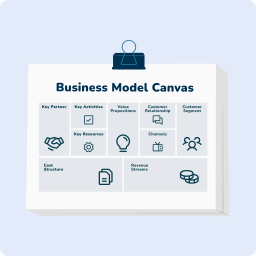
Marketing Diagnosis Activity
Students analyze a real business or pitch page to judge what a first-time visitor actually understands from it.
Marketing
KANU CLASSROOM
Ready-to-run venture experiences that drop into the course you already teach. Your students launch real businesses, the platform guides every step and tracks every outcome. No curriculum to build. No grading pile.
Backed by Reach Capital and JFF Ventures























THE PROBLEM
Designing a real project from scratch eats your weekends. A textbook chapter takes ten minutes to assign, which is exactly why textbooks keep winning.
Real customers mean storefronts, payments, and accountability. That's infrastructure, not a lesson plan, and no syllabus provides it.
Open-ended, real-world work is the hardest thing on your desk to assess fairly, and the first reason courses quietly retreat to multiple choice.

Anchor it on a pre-built syllabus that has already run at real schools: structure, student flow, and outcome tracking included.

Drop a ready-to-teach lesson plan into the syllabus you already have — one class session, prep to debrief, with a real KANU activity built in.
A KANU Experience is a ready-to-run classroom experience where students do real entrepreneurial work: pitch a real idea, talk to real customers, sell through a real storefront, or launch a full venture, depending on the experience. Every step is guided in the platform by KAI, and every outcome is verified. "Real" never means "unsupervised."
Students read about entrepreneurship. Knowledge in, nothing out.
Students practice in a fake market. Risk-free, and stakes-free. Nothing survives the last day of class.
Real, but one employer per student and a mountain of coordination that doesn't fit inside a course.

Real work, run inside your class, verified by the platform. Students keep what they build.
One class period. Plug-and-play warm-ups and skill reps students start and finish in a single session.
Multi-week venture builds. Students take a real idea to launch and gather the evidence along the way.
HOW IT WORKS
The pedagogy under the hood. Students learn a concept, do it for real with a named tool, and the result is verified as evidence, and every verified result feeds the next lesson.
Lesson: shaping an idea worth testing.
Put your pitch in front of real people with PitchLink.
Responses are recorded as the venture's evidence.
every verified result feeds the next lesson
Real entrepreneurship is hard to navigate. KAI is the compass built into every KANU experience, guiding students from first idea to verified outcome, working alongside the teacher every step. You teach; KAI keeps thirty ventures moving.

Concepts land and stay landed.

KANU Classroom
A library of hands-on entrepreneurship experiences, from one class period to a multi-week venture, that drop into your existing course.
Choose a project or activity. Each comes with pre, during, and post class prep, teaching notes, and add-ons like worksheets and slides.
Short digital training on running the experience well, before students ever join.
Invite via QR code, invite link, or bookstore digital access. Students join on the web, tablet, or the iOS and Android apps.
Run live in one class period, or set due dates along the way. Progress and completion are tracked automatically, so there's no grading pile.
By Nancy Forster-Holt. The published research behind KANU's approach: students learn entrepreneurship by running real ventures that solve real problems for real customers. A "stimulation," not a simulation.

Steve Blank & Nancy Forster-Holt · Entrepreneur & Innovation Exchange. Blank and Forster-Holt on why student side hustlers make standout hires, citing the URI course where students run real businesses on KANU, winner of USASBE's top prize in experiential learning.
Read moreA classroom exercise built on KANU, students launching real ventures instead of writing hypothetical plans, took first place among 13 national finalists.
Read moreShowing 13 testimonials.
 View case study
Breeann Gibbons
CTE Director, Julesburg School District
“KANU is easy for our students to navigate without feeling overwhelmed, and it still offers a fantastic experience. Working with the team has been a joy. We're already planning to include KANU in our next Perkins grant.”


Jeff Meade
Entrepreneurship Program Director, Paul Quinn College
“Learning happens when you actually do something, and KANU captures venture-based learning in a nutshell. It's incredible to see.”
 View case study
Teri Cady
Head of School
“Engagement was high, and that was just year one. Students respond at a much higher rate when there's a teacher behind it.”


Shorouq Almallah
Entrepreneurship Program Lead, Grand Valley State University
“KANU is very intuitive, and I love the simplicity of it. In the learning module, I see a lot of potential.”
 View case study
Galen Harkness
Business Teacher, Julesburg School District
“KANU helped me bring real-world content into the classroom. It's clever and packed with powerful content, and it made a real difference in how my students engaged.”


Teresa
Professor, University of the Incarnate Word
“Students experience entrepreneurship firsthand, launching their own online storefronts to take an idea from concept to customer. The best part is guiding students as they discover what works and when they need to pivot as they are also making connections to course concepts.”
 View case study
Dr. Nancy Forster-Holt
Professor, University of Rhode Island
“I was so tired of the hypothetical business idea. When they explained KANU, I said, you nailed it.”


Andrew Illnicki
Entrepreneurship Faculty, University of Richmond
“I love the look and feel you've developed. The features and benefits are really intuitive, which is great.”
 View case study
Regina Thompson
Wave Program, Florida Atlantic University
“It's a fun, gamified way to run our program, and it's customizable. For student entrepreneurship, it's worth trying.”

Dr. Colleen Robb
Professor, Florida Gulf Coast University
“Every class we showed the dashboard, students would come on time because they wanted to see how they stacked against their teammates.”
 View case study
Justin Heacock
Executive Director, Center for Free Enterprise and Entrepreneurship, Florida Southern College
“KANU took our incubation program from 25 students to over 400 in a single academic year. With one full-time employee, we run a full incubation program without adding staff.”


Dr. John Wilson
Drexel University
“KANU connects experience with pedagogy.”
 View case study
Dr. David Tomczyk
Professor, Quinnipiac University
“In the two years we've used KANU, the number of teams who failed to launch a business has approached zero. Our teams are more motivated to sell, on and off platform.”
Trust & safety, built in
GET STARTED
Your first activity is free with a free account. See how a real venture runs inside your class.